ADA Mobile Washroom Accessibility: What Rental Companies and Clients Need to Know
Portable toilets are frequently dealt with like a last-minute logistics product. A person remembers them after the stage is booked, the fencing is ordered, or the team schedule is set. Availability can not be dealt with this way. For individuals that use wheelchairs, walkers, canes, or merely require more room and better support, an unattainable toilet is not a small inconvenience. It can suggest being excluded from an event, struggling through a day, or having no practical means to use the facilities at all.
That is why the discussion around an ada mobile restroom demands to be a lot more severe than inspecting a box on an order form. The legal standards matter, yet so does the real-world experience of the person arriving on site and trying to make use of the restroom with dignity. Rental carriers and consumers both contribute below. One supplies the system, the various other chooses where it goes and just how the site works around it. If either side misses out on something, the easily accessible system might be practically present and still functionally unusable.
Accessibility is not almost the washroom itself
People usually picture an ada compliant mobile toilet as a larger unit with a mobility device sign on the door. That symbol matters, and the requirements do call for obtainable mobile toilet systems to be identified with the International Icon of Accessibility. However the icon alone does not make the toilet usable.
An easily accessible system needs to match an easily accessible experience from method to exit. If a guest, worker, or attendee can not reach the system due to the fact that the route is obstructed, unequal, sloppy, or separated from the remainder of the website, the trouble has actually not been resolved. If the door area does not have the required maneuvering room, the bigger cabin does not aid sufficient. If the unit is positioned at the end of a narrow path or behind tools, it ends up being easily accessible in theory and inaccessible in practice.
This is where numerous preventable errors happen. A service provider might provide the right model, however the customer positions it any place there is room. Or a consumer especially demands an ada accessible portable restroom, yet no one validates the approach, quality shifts, or bordering clearances when the trailer, obstacles, generators, and crowd-control fencing get here. By the time the event opens up or the job starts, changing placement is harder and extra expensive.
What the federal standards actually require
The regulating government ease of access standard for portable toilet leasings in the United States is the 2010 ADA Specifications for Accessible Style, as translated by the Access Board and the Division of Justice. That point is worth mentioning clearly because complication is common. Many people count on habit, old presumptions, or whatever the last supplier informed them. The requirements, not practice, control.
For collections of portable single-user toilet devices, at least 5 percent of the devices in each cluster need to be accessible. The Accessibility Board has actually made clear that this applies also at momentary occasions. That catches some coordinators off-guard due to the fact that they assume short-lived methods exempt. It does not, at the very least out that factor. If a financial institution of devices is set up for a reasonable, concert, race, event, or similar short-term use, ease of access still needs to be built into the count.
That 5 percent policy is among the simplest compliance points to bear in mind and one of the easiest to misapply. The expression "in each cluster" matters. If a website has numerous toilet places, the accessible units ought to not just be focused in one area while various other clusters are left without them. Individuals require access where the washrooms in fact are.
The criteria likewise require more than quantity. Obtainable mobile commode devices have to have an obtainable route and entryway, and any kind of required ramps or landings must comply with ADA technological requirements. Furthermore, the units have to meet toilet-room technological demands, consisting of component clearances, turning area, and door maneuvering clearances, together with suitable grab-bar and water-closet clearance rules.
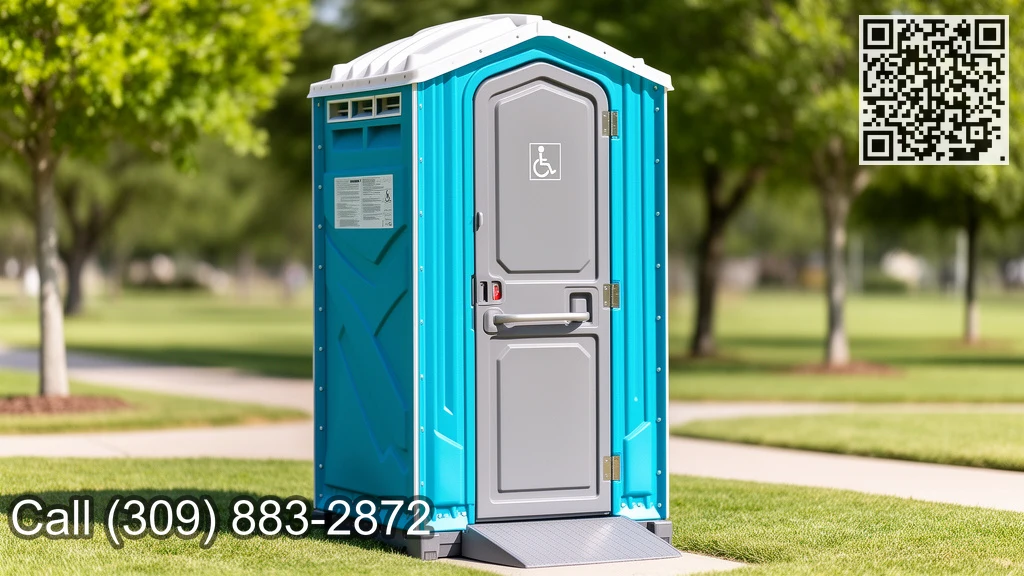
That might appear very technical, because it is. However the underlying idea is straightforward. An individual should have the ability to reach the device, enter it, move within it, make use of the toilet safely, and come back out without unnecessary barriers.
Why rental suppliers can not quit at delivery
A responsible rental company must recognize when a common device is not nearly enough. If a consumer requests "one extra-large porta potty" or "one handicap device," that should activate a much more precise discussion. Terminology in the area is unpleasant. Individuals use phrases like ada handicap obtainable mobile restroom, ada mobile toilet, or ada compliant portable toilets interchangeably, sometimes without comprehending what they are requesting. Carriers are in a strong position to clarify that the issue is not just a larger footprint. It is ADA accessibility.
That does not mean the company controls every lawful risk on the site. Placement choices, website conditions, and post-delivery obstructions can be in the customer's hands. Still, knowledgeable carriers understand that preventable issues generally start with unclear communication. If the website host has not thought of where the ada portable commode rental will rest, who will certainly access it, or whether the route continues to be functional throughout the event or task, the https://pristineportablesil.com/emergency-services/ supplier ought to elevate those questions early.
In practice, the very best operators do a little much more listening and a little much less presuming. They ask whether there will certainly be numerous restroom clusters, whether public participants will utilize the site, whether secure fencing or ticketing lanes could hinder gain access to, and whether the device needs to serve a path of travel that stays open all day. They are not working as legal representatives or examiners. They are doing what great drivers do, which is assisting the consumer prevent a foreseeable problem.
What clients frequently miss when ordering
Customers in some cases think that buying one ada compliant obtainable mobile restroom clears up the issue. It may not. The question is not merely whether an accessible system appears somewhere on the billing. The concern is whether the easily accessible holiday accommodation is proper for the site format and the number and circulation of units.
An usual instance is a large outside event with portable washrooms split right into numerous separate banks. If the organizer positions the only obtainable device at the primary entrance however has various other washroom clusters throughout the premises, individuals with mobility specials needs may have to take a trip much further than everybody else to discover a usable toilet. That weakens the function of accessibility even if the overall order consisted of one bigger unit.
Another reoccuring concern is site drift. The placement that looked fine theoretically can become an issue after configuration. A course that was originally open may wind up narrowed by barricades, goods outdoors tents, electric cables, stored materials, or parked service cars. The accessible restroom itself may continue to be untouched, but its usability disappears one obstruction at a time.
Customers likewise need to understand that construction settings are not all dealt with the same way. The ADA Specifications have distinguished portable commode units at building and construction websites utilized solely by construction personnel, which are exempt from the portable-toilet accessibility scoping demand in the pointed out 1991 criterion. That is a narrow factor and not a covering reason for all jobsite usage. For basic mobile bathroom rentals, the accessible-unit requirement stays. If the website is serving the public or more comprehensive use past that unique workers context, presumptions can obtain dangerous extremely quickly.
The expression "momentary occasion" creates more complication than nearly anything else
I have actually seen organizers deal with "momentary" as if it wipes away accessibility responsibilities. It does not. The Accessibility Board has especially stated that the need for at least 5 percent obtainable systems in each collection applies even at momentary events.
That matters since many of the websites where mobile restrooms are most heavily made use of are momentary naturally. Road celebrations, showing off occasions, seasonal fairs, pop-up places, emergency feedback support areas, temporary activation websites, and community celebrations all depend upon mobile hygiene. If ease of access were optional every single time an event lasted a weekend as opposed to a year, the result would certainly be exclusion on a huge scale.
Temporary websites really need extra preparation, not less. Long-term buildings a minimum of start with dealt with entryways, routes, and bathroom areas. Short-lived sites are assembled from square one, which implies every gain access to choice is intentional. That develops both danger and possibility. When individuals pay attention early, they can get it right. When they improvise on program day, they normally miss something important.
A useful way to think of conformity on site
The standards are described, but the area questions can be minimized to a simple series. Can people find the obtainable unit, can they reach it, can they enter it, and can they use it as meant? If the answer breaks at any factor, the obtainable experience is incomplete.
For rental providers and customers, that develops into a brief working list:
- Confirm the amount of toilet collections the website will have, not just the overall number of units.
- Make sure at least 5 percent of single-user devices in each cluster are accessible.
- Verify that each accessible device is understood the International Symbol of Accessibility.
- Check that the path and entrance are accessible, including any type of ramps or touchdowns that might be needed.
- Recheck the location after last website arrangement so obstacles included later on do not block access.
That last factor is worthy of more interest than it usually obtains. Many availability failings are not present at delivery. They show up later on, after everybody else has actually completed setting up. A bathroom can arrive in a usable location at 8 a.m. And come to be inaccessible by midday due to the fact that pallets, barriers, cables, or momentary frameworks were put nearby.
The washroom interior issues as much as the route
When individuals think of an ada-compliant mobile toilet, they typically focus on exterior size or whether a mobility device can make it through the door. The indoor demands are just as crucial. The unit must satisfy toilet-room technical demands that include component clearances, turning space, and door maneuvering clearances, together with appropriate grab-bar and water-closet clearance rules.
Even without reciting measurements, the concept is easy to understand. Available usage requires adequate space to move, position, transfer, and departure safely. A toilet that is bigger than common but poorly prepared can still fail the person using it. Extra flooring area does not automatically suggest correct clearances. That is why true ada compliant mobile restrooms are not simply basic devices stretched a bit wider. They are made around access use conditions.
For consumers, this is one reason not to replace uncertainty for appropriate tools. "Roomy" is not the like certified. "Mobility device pleasant" is not a technological group. If you need an ada certified mobile toilet, state that directly and collaborate with a provider that comprehends the distinction.
Signage is not a small detail
The need that accessible mobile bathroom units be related to the International Icon of Ease of access may sound small compared with course and clearance issues, yet it plays a sensible duty. On a crowded site, people need to be able to locate the unit rapidly. Signs likewise signifies intent. It informs personnel, service providers, and guests that the system is booked as an obtainable feature of the website, not simply a large stall to be delicately repurposed or blocked.
I have seen sites where the available unit was used as storage space just due to the fact that it had much more indoor area. In some cases it held added paper supplies, cleaning tools, or boxes waiting to be unpacked. No one believed they were creating a serious issue. They were simply capitalizing on void. Yet that kind of abuse can totally defeat gain access to. Clear recognition helps reduce that temptation, though it does not change guidance and typical sense.
Rental agreements do not change website judgment
A great deal of stress in this field comes from separated responsibility. The service provider might claim, fairly, that it supplied the correct ada-compliant mobile restrooms The consumer might state, also rather, that they depend on the company's know-how. Both statements can be true, and neither fixes the instant problem for the person who can not make use of the restroom.
The better method is to deal with ease of access as a common functional duty. Service providers ought to supply the ideal systems and ask smart questions. Clients ought to prepare the website with access in mind and preserve that accessibility via the life of the service. If there are several vendors on site, somebody needs to have the final walk-through of toilet access after all devices, fencing, hosting, and traffic-control components are installed.
This issues a lot more now since ADA compliance is not reducing right into the background. The more comprehensive conformity environment is active. One current indication of that is the Department of Justice assistance prolonging the deadline for certain state and city government web and mobile access rules to April 26, 2027 for bigger entities. That update is about electronic access, not portable restrooms, but it mirrors a wider fact. Ease of access obligations are being proactively dealt with throughout industries, and companies must expect analysis, not drift.
Construction websites require mindful reading, not wide assumptions
The building context deserves a different word since it is typically misconstrued. There is a details distinction in the ADA Requirements concerning mobile toilet devices at construction websites made use of solely by building employees. That exclusive-use setup is treated differently under the cited 1991 scoping language. However people often find out about that exception secondhand and then use it much also broadly.
If there is any public-facing usage, combined use, or basic portable commode rental context, the more secure habit is to quit thinking and start examining. Exemptions in accessibility legislation have a tendency to be narrower than people want them to be. A superintendent, task supervisor, or event coordinator that waves off accessibility based on an unclear memory of a building and construction exception can quickly make a negative call.
For providers, this is an additional location where mindful language issues. If a client uses building and construction terms, that does not instantly mean the exception applies. Ask that will make use of the devices. Ask whether the location is minimal exclusively to building personnel. Ask whether there are separate public-facing stages, sales locations, inspections, or events. A five-minute explanation can avoid an expensive mistake.
How to avoid the most common failures
The area failings often tend to be repetitive. The exact same patterns show up time and again, normally due to the fact that individuals are scooting and no one reduces the process down enough time to inspect gain access to from the customer's factor of view.
Here are the troubles I see frequently in practice:
- Ordering too few easily accessible units since the group considered the total website count rather than each cluster.
- Placing the available device where distribution is easiest instead of where the course is usable.
- Letting later on setup tasks block the entry or maneuvering area.
- Assuming a larger device is automatically ADA compliant.
- Treating short-term events as if they are exempt from availability scoping.
None of these mistakes are exotic. They are average planning blunders, which is why they occur so often. The encouraging component is that they are likewise avoidable. Accessibility troubles with portable washrooms are seldom regarding difficult design. More often, they are about focus, interaction, and appreciating the criteria early sufficient to act on them.
Good accessibility work feels average to the user
That is the conventional individuals must go for. Not praise for having "exceeded and beyond." Not gratitude because an individual with a special needs handled to navigate a challenging configuration. Just a normal, usable restroom experience.
When an ada mobile toilet is appropriately chosen, correctly determined, and positioned on an obtainable course with a functional entrance and ideal indoor clearances, it quits being a special function and becomes what it needs to have been from the start, part of a functioning site. That is the real goal.
For rental suppliers, this indicates structure ease of access into sales discussions, send off behaviors, and area checks. For customers, it suggests dealing with washroom accessibility as part of site planning, not an afterthought. Both sides need to keep in mind that conformity is not just regarding avoiding problems. It has to do with whether a person can get involved fully in case, do their work, or just survive the day without unnecessary barriers.
The phrase ada portable bathroom requirements can sound completely dry, almost governmental. However behind those requirements is something deeply useful and human. People need risk-free, usable bathrooms. When availability is dealt with well, a lot of individuals never see the preparation that made it feasible. They simply utilize the facility and proceed with their day. That is not a tiny result. It is precisely what good gain access to is supposed to feel like.
 Ask ChatGPT
 Ask Grok
 Ask Perplexity
 Ask Claude
 Ask Google AI
 Ask You